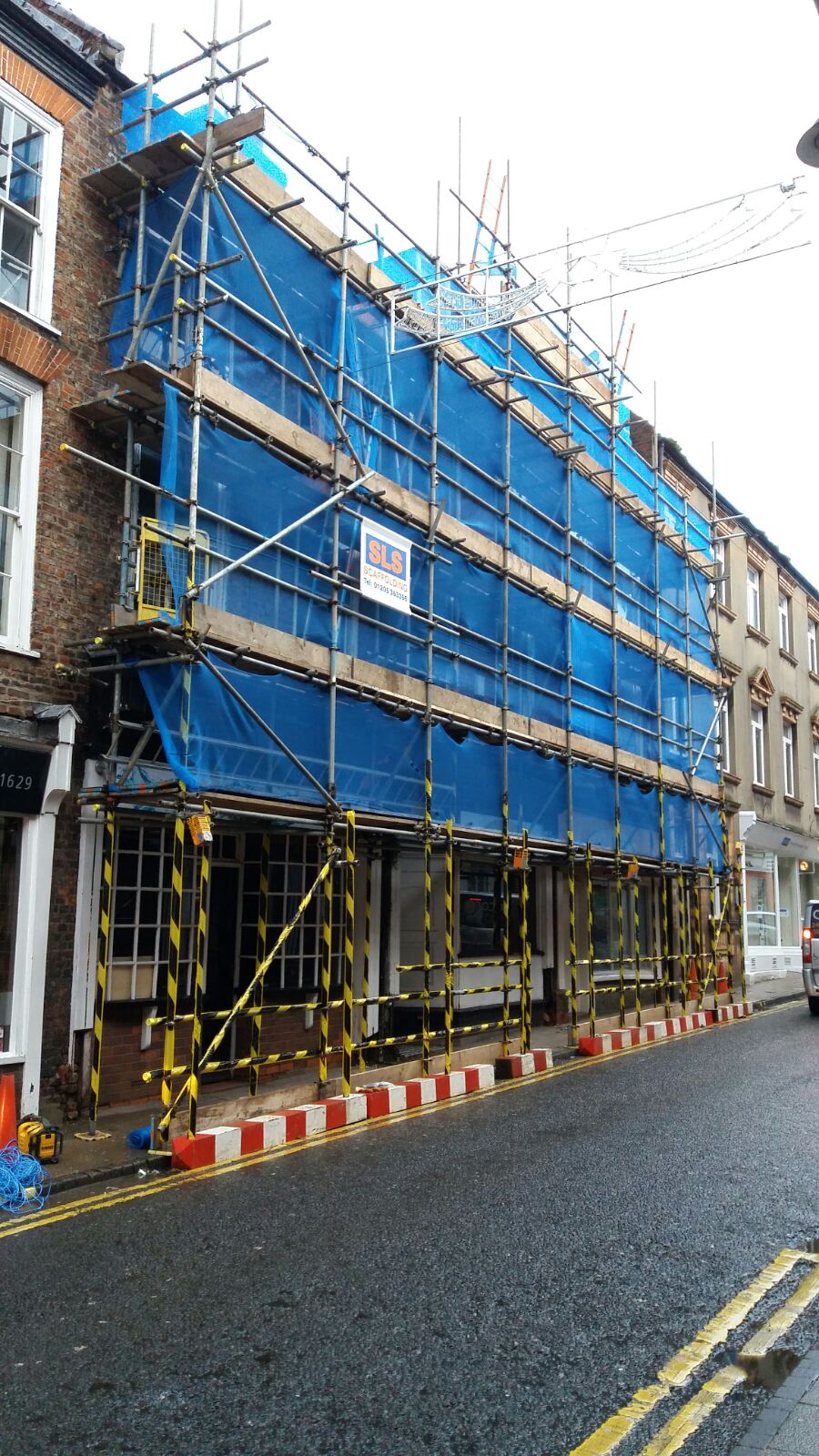
Plenty of buildings in Lincolnshire’s market towns sit right on the pavement. Shops, banks, chapels, terraces: the front wall is the edge of the footpath. So when one of them needs work at height, the scaffold has to stand on the public highway, and that means a licence comes first.
What the licence is
Under section 169 of the Highways Act 1980, nobody may put up a scaffold on a road or pavement without a licence from the highway authority. In Lincolnshire that is Lincolnshire County Council. Hoarding round a site on the highway is covered in the same way.
The licence is the council’s way of making sure the footpath stays safe while the work goes on. It usually sets out how long the scaffold can stay, how much of the pavement it can take, and what has to be done to protect people walking past.
What the council will want to see
- Where and how big. The address, the length of frontage, and how far out from the building the scaffold will stand.
- How long. The dates it goes up and comes down. If the job overruns, the licence needs extending before it runs out.
- Insurance. Proof of public liability cover from whoever is putting the scaffold up.
- How the public is kept safe. Usually a clear walkway under or around the scaffold, protected uprights at ground level, lighting at night and fans or netting to stop anything falling.
Who applies?
In most cases the scaffolding contractor applies, because they are the one putting it up, they hold the insurance and they know the details the council asks for. It is still worth checking with whoever you are using, so nobody assumes the other one has done it.
Start early
Councils need time to process an application, and the time varies with the council and the season. A licence that has not come through is one of the commonest reasons a start date slips, so mention it as soon as you know the scaffold will stand on the highway.
A few other things can need sorting at the same time:
- Parking. If the lorry needs to stop where parking is restricted, or a bay has to be suspended while the scaffold goes up, that is arranged separately.
- Road space. A scaffold or a loading bay that takes part of the carriageway may need a traffic management plan as well.
- Neighbours. If the scaffold will cross in front of next door, have a word with them before the lorry turns up.
While it is up
The scaffold has to be kept as the licence says until it comes down: lit at night, the walkway clear, the protection in place. The scaffolder inspects it at least every seven days and after bad weather, as the Work at Height Regulations require, and records each inspection.
When the work is finished, the scaffold comes down, the pavement is left as it was found and the licence ends.
Got a building on the street?
Tell us the address and what the work is, and we will tell you what the scaffold needs.
Ask for a quote